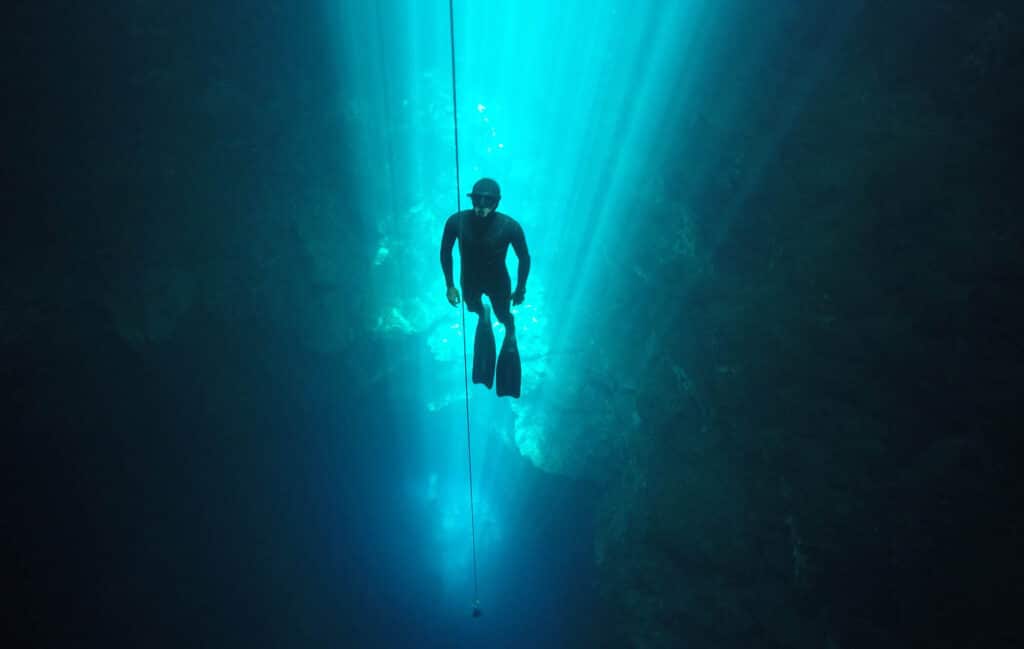
A freediving school may offer beginner certifications, advanced depth training, pool programs, specialty courses, coaching, instructor development, and courses from one or several certification agencies.
Putting all of those options on a single “Freediving Courses” page may seem convenient.
From an SEO and user-experience perspective, however, it can create a problem.
Someone searching for a beginner certification has different questions from an experienced freediver looking for an advanced course. A student researching equalization training has different intent from someone comparing complete certifications. A traveler searching for a freediving course in Mexico, Greece, Bali, or another destination may also need information about local water conditions, course schedules, training sites, and the best season to visit.
Effective SEO for freediving certification courses begins by matching each important search intent with the right page.
The goal is not to create as many pages as possible. It is to create a logical website architecture in which each certification level, specialty, and relevant location has a clear purpose.
Google recommends logical site structures, informative titles and headings, contextual internal links, and avoiding repetitive content. It also uses links to discover pages and understand their relevance.
For freediving centers, this creates an opportunity to build a course structure that works equally well for students and search engines.
This guide explains how.
Why SEO for Freediving Certification Courses Requires a Different Strategy
Freediving training is not a single product.
It is a progression.
Students may move from an introductory experience into a complete beginner certification, then continue into advanced depth training, specialty skills, coaching, safety education, or professional-level programs.
Major training organizations illustrate this progression differently.
PADI currently presents certifications including Basic Freediver, Freediver, Advanced Freediver, and Master Freediver. SSI uses program names including Basic Freediver, Freediver, Advanced Freediver, and Performance Freediver, along with specialty programs. Molchanovs separates pool-focused Lap programs from Wave programs that incorporate open-water training.
That means students do not always search simply for:
freediving course
They may search for much more specific terms such as:
- beginner freediving certification
- advanced freediving course
- freediving level 1 course
- freediving level 2 certification
- freediving equalization course
- free immersion course
- pool freediving certification
- Molchanovs Wave 1 course
- PADI Freediver course
- SSI Freediver certification
- freediving course in [destination]
- advanced freediving training in [destination]
Your website architecture should reflect these different intentions.
The Core SEO Principle: One Page, One Primary Search Intent
A useful rule for SEO freediving certification courses architecture is:
One important search intent should have one clear primary page.
That does not mean every keyword requires a new URL.
Several closely related keywords can belong on the same page.
For example:
Freediving Level 1 Course
Beginner Freediving Certification
Learn to Freedive
Entry-Level Freediving Course
may all describe essentially the same product.
Those terms could therefore be covered naturally on one strong beginner certification page.
By contrast:
Beginner Freediving Certification
and
Advanced Equalization Workshop
represent substantially different products and search intentions.
Those deserve separate pages if the school genuinely offers both.
Recommended Website Architecture for Freediving Courses
A scalable structure can look like this:
Freediving Courses Hub
→ Beginner Certification
→ Intermediate / Advanced Certification
→ Master / Performance Certification
→ Pool Freediving
→ Specialty Courses
→ Instructor Courses
→ Training & Coaching
→ Course Locations
The exact terminology should reflect the agency or agencies you teach.
For example:
| Page Type | Example URL | Primary Purpose |
|---|---|---|
| Main course hub | /freediving-courses/ | Compare all programs |
| Beginner certification | /freediving-courses/beginner/ | Convert first-time students |
| Advanced certification | /freediving-courses/advanced/ | Capture progression searches |
| Master/performance | /freediving-courses/master/ | Advanced training searches |
| Specialty hub | /freediving-specialties/ | Compare specialty training |
| Equalization specialty | /freediving-specialties/equalization/ | Specific skill intent |
| Free immersion specialty | /freediving-specialties/free-immersion/ | Discipline-specific intent |
| Instructor course | /freediving-instructor-course/ | Professional training |
| Destination page | /freediving-courses/cozumel/ | Location-based course searches |
The objective is not to copy these URLs exactly.
The objective is to make the relationship between courses immediately understandable.
Google recommends crawlable URLs and links between important pages so both users and Google can discover the site structure.
Build a Main Freediving Courses Hub Page
The central Freediving Courses page should not try to rank for every individual certification query.
Its primary role is comparison and navigation.
Think of it as the page that answers:
Which freediving course is right for me?
A strong hub page should briefly introduce:
- The certification agency or agencies offered
- Beginner courses
- Intermediate courses
- Advanced courses
- Pool programs
- Specialty courses
- Instructor programs, if offered
- Typical progression paths
- Locations
- Course availability
- Links to detailed course pages
It should provide enough information for a visitor to choose a direction without reproducing every detail from the individual pages.
Use a Course Comparison Table
Comparison tables are especially useful for certification websites because students often do not understand the differences between levels.
For example:
| Course | Best For | Previous Certification | Main Training Environment | Next Step |
|---|---|---|---|---|
| Beginner Freediver | New freedivers | Usually none | Pool + open water | Advanced course |
| Advanced Freediver | Certified beginners | Entry-level certification | Pool + deeper open water | Performance/master level |
| Performance / Master | Experienced freedivers | Advanced certification | Advanced pool + depth | Coaching or professional pathway |
| Pool Program | Pool-focused students | Varies | Pool/confined water | Open-water upgrade |
| Specialty Course | Skill development | Depends on specialty | Pool or open water | Additional specialty or higher certification |
Requirements vary by training agency, so each actual page should list the standards that apply to the specific certification being sold.
Do not mix requirements from several agencies and present them as universal freediving standards.
Create a Dedicated Page for Every Major Certification Level
If a certification is a meaningful standalone product that students can book, it usually deserves its own page.
This gives each level enough space to answer the questions students actually have before registering.
For example:
Beginner Freediving Certification Page
This page should target beginner intent.
Potential keyword themes include:
Primary keyword:
beginner freediving course
Secondary keywords:
- freediving certification for beginners
- learn freediving
- entry-level freediving certification
- first freediving course
- freediving lessons for beginners
The content should reassure a student who may have never held their breath underwater beyond recreational snorkeling.
Advanced Freediving Certification Page
This page addresses someone who already understands freediving fundamentals.
Possible keyword themes include:
- advanced freediving course
- advanced freediving certification
- level 2 freediving course
- advanced depth training
- intermediate freediving course
The content should therefore focus less on explaining what freediving is and more on progression.
Master or Performance Freediving Page
Higher-level pages should address more experienced students.
Search intent may include:
- master freediver course
- performance freediving course
- advanced depth freediving training
- level 3 freediving certification
- deep freediving course
These visitors may already understand static apnea, dynamic disciplines, constant weight, free immersion, equalization, and safety procedures.
Writing introductory content as though they are complete beginners wastes valuable space.
Match the Page to the Training Agency
Certification terminology is important.
A student may search specifically for the organization whose certification they already hold.
PADI, SSI, Molchanovs, AIDA, and other agencies do not necessarily use identical names or progression systems.
For example, Molchanovs currently differentiates between Lap courses, which focus on theory and pool requirements, and Wave courses, which also incorporate open-water depth training. Its progression includes Wave 1 through Wave 4.
SSI currently distinguishes programs such as Basic Freediver, Freediver, Advanced Freediver, and Performance Freediver. It also offers specialty training such as Free Immersion.
PADI presents a progression that includes Basic Freediver, Freediver, Advanced Freediver, and Master Freediver.
Use the terminology associated with the certification you actually provide.
Should Different Certification Agencies Have Separate Pages?
Usually, yes—when the courses are genuinely different products and the search intent differs.
Imagine a school offers:
- Molchanovs Wave 1
- PADI Freediver
- SSI Freediver
Creating one page called Beginner Freediving Course and mentioning all three may work as a comparison page.
But if students can independently book each certification, dedicated pages may be more useful:
/padi-freediver-course/
/ssi-freediver-course/
/molchanovs-wave-1-course/
Each page can then explain:
- Agency
- Certification awarded
- Prerequisites
- Curriculum
- Training standards
- Course duration
- Pool requirements
- Open-water sessions
- Performance requirements
- Materials
- Price
- What’s included
- Next certification
- Booking availability
The pages must contain genuinely distinct information.
Do not create three nearly identical pages and simply replace the agency name.
Avoid Certification Page Cannibalization
Keyword cannibalization occurs when multiple pages on the same website compete for essentially the same search intent.
For example:
/freediving-level-1/
/beginner-freediving/
/learn-freediving/
/freediving-certification-beginners/
may be unnecessary if they all sell exactly the same course.
A stronger strategy would normally be one comprehensive page that naturally addresses all relevant terms.
The additional URLs can create confusion for users, complicate internal linking, and divide signals that could have supported one stronger page.
Before creating a new page, ask:
Does this page answer a meaningfully different question or sell a distinct course?
If the answer is no, improve the existing page instead.
How to Structure an Individual Freediving Certification Page
Every certification page should follow a consistent framework while still containing unique information.
A practical layout is:
H1: Course Name + Location or Clear Benefit
Example:
PADI Freediver Course in Cozumel
or
Advanced Freediving Certification: Improve Depth, Technique and Safety
Then structure the page with H2 sections.
H2: About the Freediving Course
Begin with a concise explanation of:
- Who the course is designed for
- Certification agency
- Experience level
- Main objective
- Type of training
- Expected outcome
Do not begin with several paragraphs of generic content about how beautiful or peaceful freediving is.
The visitor searched for a course.
Answer that intent immediately.
H2: Who Is This Course For?
This section helps students determine whether they are in the right place.
For a beginner course, you might explain that it is intended for:
- People new to formal freediving
- Snorkelers wanting proper safety training
- Scuba divers interested in breath-hold diving
- Spearfishers wanting stronger freediving fundamentals
- Travelers wanting a recognized freediving certification
For an advanced course, explain the expected previous experience.
H2: Freediving Course Prerequisites
Prerequisites are one of the most important conversion sections.
Include the applicable:
- Minimum age
- Previous certification
- Medical requirements
- Swimming ability
- CPR/first-aid requirements where applicable
- Minimum experience
- Equipment requirements
Never invent universal prerequisites.
Use the official standards for the certification being offered.
H2: What You Will Learn
This should be specific.
Potential skills include:
- Breathing and relaxation
- Breath-hold physiology
- Equalization
- Duck diving
- Finning technique
- Streamlining
- Free immersion
- Constant weight
- Static apnea
- Dynamic apnea
- Buoyancy
- Recovery breathing
- Rescue procedures
- Buddy safety
- Depth progression
Only include skills actually taught in the course.
H2: Freediving Safety Training
Safety deserves its own section.
Freediving certification is not simply about increasing depth or breath-hold times.
Students also need to understand buddy systems, supervision, recovery procedures, and emergency response appropriate to their training level.
This section can also strengthen user trust because it demonstrates that the school is not marketing depth achievements without explaining the safety framework behind them.
H2: Course Schedule and Duration
Students often want to know exactly how the course fits into their trip.
Explain:
- Number of days
- Approximate hours
- Theory sessions
- Pool sessions
- Open-water sessions
- Typical starting times
- Whether sessions may change according to conditions
- Whether additional training days are available
Avoid simply saying “2–3 days.”
Give students an idea of what those days look like.
H2: Certification Requirements
Students should understand the difference between taking a course and earning a certification.
Explain applicable:
- Knowledge requirements
- Skill requirements
- Static requirements
- Dynamic requirements
- Open-water requirements
- Depth requirements
- Safety evaluations
The exact standards depend on the agency and course.
For example, PADI currently describes different training ranges for Freediver, Advanced Freediver, and Master Freediver certifications, while Molchanovs publishes separate performance expectations across Wave levels.
Use current agency documentation when publishing numeric standards.
H2: What Is Included
This section removes booking uncertainty.
Possible inclusions include:
- Instructor
- Certification fees
- Digital learning
- Pool entry
- Open-water sessions
- Freediving equipment
- Buoy and line system
- Transportation
- Photos or videos
- Water
- Course materials
Be precise.
If rental equipment costs extra, say so.
H2: What Students Need to Bring
Include practical preparation information.
For example:
- Swimwear
- Towel
- Water bottle
- Sun protection
- Freediving equipment if required
- Certification card
- Medical documentation where applicable
- Warm clothing between sessions
This kind of content improves both SEO depth and customer experience because it answers questions that otherwise generate emails or WhatsApp messages.
H2: What Happens After Certification?
This is one of the most underused sections on freediving websites.
Every course page should naturally lead somewhere.
A beginner certification page might link to:
Advanced Freediver Course
An advanced page might link to:
Depth Training
Equalization Coaching
Free Immersion Specialty
Master / Performance Certification
A performance-level course might lead to:
Instructor Training
Competition Coaching
Safety Training
This creates a logical student progression and internal linking structure.
Structure Freediving Specialty Course Pages Separately
Specialties should not simply be buried at the bottom of a certification page when they represent standalone training products.
Examples may include:
- Free immersion
- Monofin
- No-fins technique
- Advanced equalization
- Training techniques
- Safety
- Competition preparation
- Depth coaching
- Pool coaching
SSI, for example, currently publishes a standalone Free Immersion specialty with its own prerequisites, training sessions, duration, and training standards.
That is exactly the type of product that can justify an independent page.
Certification Pages vs. Specialty Pages
| Certification Page | Specialty Page |
|---|---|
| Builds broad freediving competency | Develops a specific skill |
| Usually part of a progression | Often supplements certification |
| Broader search intent | Narrower search intent |
| Multiple disciplines | Usually one skill or discipline |
| Strong first-time student demand | Often intermediate/advanced demand |
| Leads to next certification level | Leads to related training |
The SEO strategy should reflect this difference.
Create a Freediving Specialty Hub
If the business offers multiple specialties, create one central page:
/freediving-specialty-courses/
Use it to compare specialties and link to detailed pages.
For example:
Improve Equalization
Link to the equalization course.
Improve Free Immersion
Link to Free Immersion training.
Improve Pool Performance
Link to dynamic apnea or pool coaching.
Prepare for Competition
Link to competition training.
This gives users a logical route through the training catalog.
Build Location Pages Only When There Is Real Local Value
Freediving is also a travel product.
A student may search:
freediving course Mexico
freediving certification Cozumel
freediving course Playa del Carmen
freediving course Bali
freediving certification Dahab
Location pages can therefore be highly valuable.
But they should not be mass-produced by changing city names.
A good destination course page needs genuine local information.
What to Include on a Freediving Course Location Page
A local page can explain:
- Courses available at that destination
- Training site
- Pool facilities
- Typical open-water environment
- Access to depth
- Boat vs. shore training
- Water temperature
- Visibility
- Currents
- Seasonal weather
- Typical sea conditions
- Wetsuit recommendations
- Accommodation areas
- Transportation
- Meeting points
- Nearby activities
- Best months for training
This makes the page useful even before the student books.
Best Time for Freediving Certification Courses
For SEO purposes, “best time” content is especially valuable on destination pages.
The answer will depend on the training location.
Factors that may affect the experience include:
- Water temperature
- Visibility
- Wind
- Waves
- Currents
- Rainy seasons
- Hurricane or cyclone seasons
- Boat accessibility
- Surface conditions
- Tourist demand
Do not make universal claims such as:
“Summer is the best time for freediving.”
That may be completely wrong for a particular destination.
Instead, explain the actual local conditions month by month when sufficient information is available.
A useful table could look like this:
| Season | Water Conditions | Freediving Training | Practical Consideration |
|---|---|---|---|
| Peak season | Generally favorable | High course demand | Book early |
| Shoulder season | Often variable but workable | Good availability | Check conditions |
| Rainy/windy period | Conditions may change frequently | Training depends on site | Keep schedule flexible |
| Off-season | Destination-specific | May offer quieter training | Verify operator schedule |
Replace generic descriptions with accurate local information before publishing.
When Should Course Pages Be Updated?
Certification websites should not wait until information becomes obviously outdated.
A practical SEO maintenance schedule is:
| Update Frequency | What to Review |
|---|---|
| Monthly | Dates, availability, prices, booking links |
| Seasonally | Conditions, schedules, seasonal copy |
| When agency standards change | Prerequisites, course names, requirements |
| Annually | Titles, descriptions, images, internal links |
| After adding a new course | Hub pages, navigation, schema, internal links |
| After Search Console changes | Queries, CTR, rankings, page overlap |
Certification organizations can change course names and standards.
SSI, for example, changed several freediving program names in 2023, including renaming Freediving L1 to Freediver, L2 to Advanced Freediver, and L3 to Performance Freediver.
That illustrates why older SEO pages should be reviewed instead of left untouched indefinitely.
Write SEO Titles for Freediving Course Pages
Every major course page should have a distinct, descriptive title.
Google recommends concise and descriptive title elements and can also use headings, page content, and link text when generating search result titles.
Examples:
| Page | SEO Title Example |
|---|---|
| Course hub | Freediving Certification Courses in Mexico |
| Beginner | Beginner Freediving Course & Certification |
| PADI | PADI Freediver Course in Cozumel |
| SSI | SSI Freediver Certification in Mexico |
| Molchanovs | Molchanovs Wave 1 Freediving Course |
| Advanced | Advanced Freediving Certification Course |
| Equalization | Freediving Equalization Course & Training |
| Free Immersion | Free Immersion Freediving Course |
| Instructor | Freediving Instructor Course & Certification |
Avoid titles such as:
Freediving | Courses | Training | Mexico | Best Freediving | School | Certification
That is not useful to the reader and looks overoptimized.
Write Unique Meta Descriptions
A meta description should summarize the specific page and give the searcher a reason to click.
Google primarily generates snippets from page content but may use a page’s meta description when it provides an appropriate summary.
Example for a beginner page:
Learn freediving with a certified instructor. Explore course skills, prerequisites, pool and open-water training, certification requirements, and dates.
Example for an advanced page:
Advance your freediving technique, equalization, safety, depth, and efficiency with structured pool and open-water certification training.
Do not reuse one meta description across every course page.
Use Clear H1 and H2 Structure
The H1 should immediately identify the course.
Example:
Molchanovs Wave 1 Freediving Course in Mexico
Then use H2 sections based on the student’s questions:
About Wave 1
Who Is This Course For?
Course Prerequisites
What You Will Learn
Pool Training
Open-Water Training
Certification Requirements
Course Schedule
What’s Included
What to Bring
Training Location
Best Time to Take the Course
Price and Availability
What Comes After Wave 1?
Frequently Asked Questions
This structure is easier to scan than several long paragraphs under one generic heading.
Internal Linking for Freediving Course SEO
Internal links are essential to this strategy.
Google uses links to discover pages and as signals for understanding relevance. It also recommends descriptive, concise anchor text rather than generic phrases such as “click here.”
For example, instead of:
Click here for the next course.
write:
Continue your training with our Advanced Freediving Certification.
Instead of:
Learn more.
write:
Explore our Free Immersion Freediving Course.
The anchor text tells both the visitor and the search engine what to expect.
Recommended Internal Linking Structure
A certification website can create a natural training pathway:
Freediving Courses
↓
Beginner Certification
↓
Advanced Certification
↓
Performance / Master Certification
↓
Instructor Training
Specialty pages can connect horizontally:
Advanced Certification
→ Equalization Training
→ Free Immersion
→ Pool Coaching
→ Depth Coaching
→ Safety Training
Destination pages can link into the same architecture:
Freediving in Cozumel
→ Beginner Course
→ Advanced Course
→ Private Training
This creates a connected topic cluster instead of isolated pages.
Use Breadcrumbs
Breadcrumbs make a large training website easier to navigate.
For example:
Home > Freediving Courses > Advanced Freediver
or:
Home > Freediving Specialties > Free Immersion
Google explains that breadcrumb markup can communicate a page’s position within the site hierarchy and help users navigate back through that structure.
This becomes increasingly useful as the number of courses grows.
Course Structured Data for Freediving Certification Pages
Freediving schools should also evaluate Google’s current Course structured data documentation.
Google supports Course markup for educational programs involving a defined curriculum, lessons or modules, instructors, students, and an educational outcome. That definition can fit legitimate freediving certification courses when implemented correctly.
Google’s current Course list documentation requires at least three courses for eligibility for its course-list feature and supports courses distributed across separate detail pages when connected through the appropriate ItemList structure.
This makes the hub-and-detail-page architecture particularly relevant.
For example:
Freediving Certification Courses
could list:
- Beginner Freediver
- Advanced Freediver
- Performance Freediver
with each linking to its individual course URL.
Structured data does not guarantee a rich result, but it can help search engines understand page content more clearly. Google explicitly notes that following structured-data guidelines does not guarantee appearance in a particular search feature.
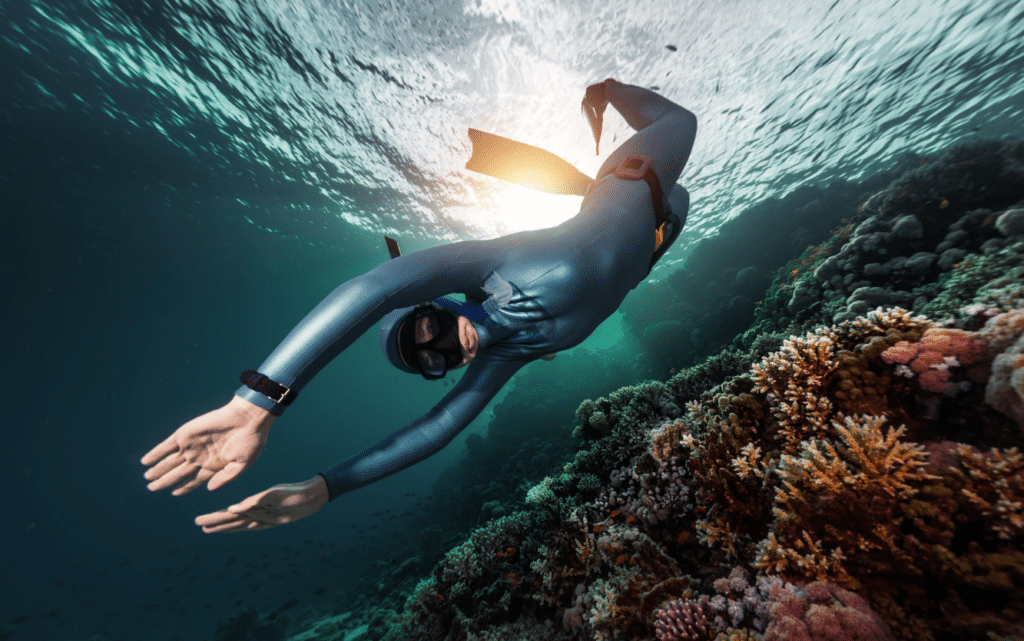
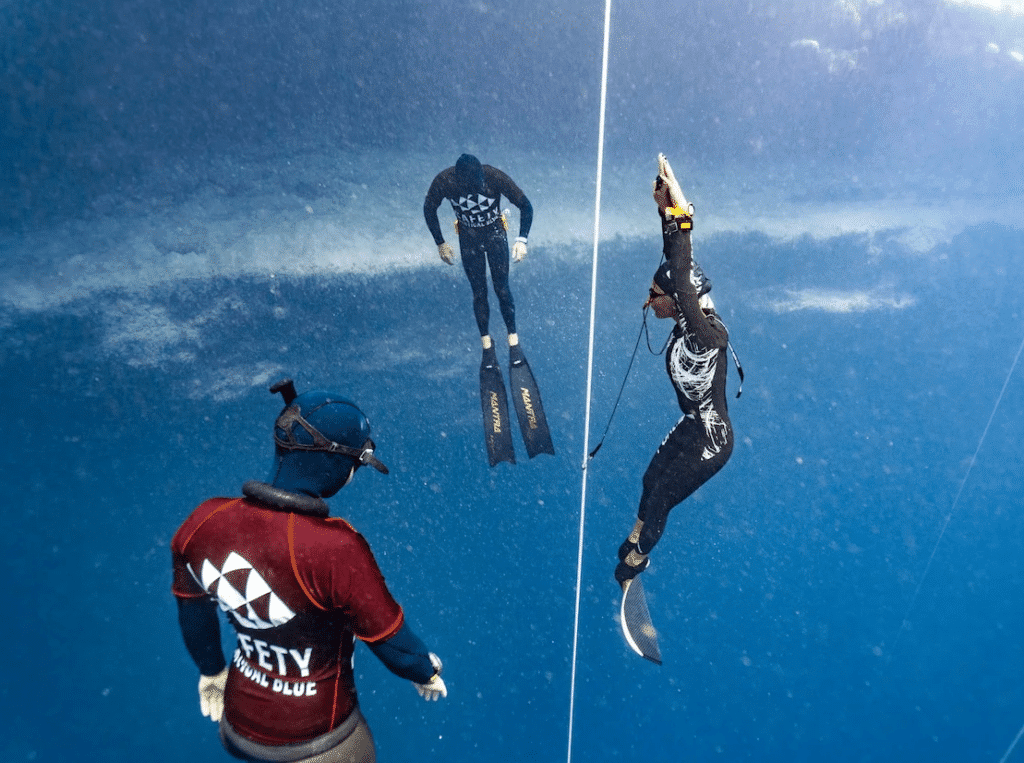
Optimize Freediving Course Images
Freediving is highly visual, but course images should support the training story rather than simply decorate the page.
Useful images include:
- Instructor briefing students
- Equalization training
- Pool dynamic training
- Safety practice
- Freediver using a line
- Free immersion
- Constant weight diving
- Buddy supervision
- Surface recovery
- Training buoy
- Course group
- Local training environment
Avoid using only dramatic deep-diving images on beginner pages.
A first-time student may interpret those photographs as evidence that the course is too advanced.
Images should help users understand what they will experience.
Show the Student Experience
Course pages frequently explain standards while ignoring experience.
Both are important.
A student may want to know:
Will I be comfortable?
Will everyone be more experienced than me?
What happens if I cannot reach the required depth immediately?
How large are groups?
How much time is spent in the water?
Are courses competitive?
Can nervous beginners participate?
Address these questions directly.
SEO content is more effective when it solves the concerns behind the search rather than merely repeating keywords.
Introduce the Instructor
Freediving training involves trust.
Course pages should therefore introduce the instructor or link clearly to an instructor profile.
Useful information includes:
- Certification
- Instructor level
- Training agency
- Experience
- Languages
- Teaching philosophy
- Competitive experience, if relevant
- Safety qualifications
- Local knowledge
Avoid vague claims such as:
“Learn from the best freediving instructor.”
Provide evidence instead.
Use Reviews on the Relevant Course Pages
Reviews become more persuasive when they match the product.
A testimonial saying:
“Amazing experience!”
provides very little information.
A beginner-course review describing how the instructor helped the student improve equalization or become comfortable during their first open-water sessions is much more useful on a beginner certification page.
Where possible, categorize testimonials around:
- Beginners
- Advanced students
- Safety
- Equalization
- Instructor quality
- Depth progression
- Private coaching
- Course organization
This creates more relevant social proof.
Price Pages vs. Individual Course Pricing
Students searching for certification courses frequently want price information.
Where practical, place the price on the actual course page.
For example:
Course price: $XXX
Certification fee: Included
Equipment: Included
Pool access: Included
Open-water sessions: Included
If prices change regularly, the page should clearly direct students to current rates.
Avoid forcing students to contact the company simply to discover basic pricing unless the course genuinely requires a custom quote.
Create Strong Calls to Action
Every course page needs a clear next step.
Possible CTAs include:
Book Your Freediving Course
Check Upcoming Course Dates
Ask About Certification Dates
Reserve Your Training
Talk to a Freediving Instructor
Avoid placing five different CTAs with equal emphasis.
Choose a primary conversion goal.
Add Upcoming Course Dates
Course dates can significantly improve usability.
Instead of:
Contact us for availability
consider providing:
| Course | Start Date | Duration | Availability |
|---|---|---|---|
| Beginner Freediver | May 10 | 2 days | Available |
| Advanced Freediver | May 17 | 3 days | 2 spaces |
| Equalization Workshop | May 22 | 1 day | Available |
Keep this information current.
An outdated course calendar damages trust quickly.
Use FAQs to Capture Long-Tail Search Intent
FAQs are useful because certification students ask highly specific questions.
Examples include:
Do I need previous freediving experience?
How deep do I need to dive to become certified?
Can I take a freediving course if I cannot equalize?
Do I need my own freediving equipment?
How many days does certification take?
Can I complete theory online?
What happens if weather cancels open-water training?
Can I complete the course if I do not reach the certification requirements?
Is freediving certification accepted internationally?
Can I upgrade from another certification agency?
Answer the question directly before adding additional explanation.
Create Supporting Informational Content
Commercial course pages should be supported by educational articles.
Useful topic clusters include:
Beginner Education
- What is freediving?
- How to start freediving
- Freediving equipment for beginners
- How freediving certification works
Safety
- Why freedivers use a buddy system
- Understanding freediving blackout
- Recovery breathing
- Freediving safety basics
Technique
- Freediving equalization techniques
- Frenzel equalization
- Free immersion explained
- Constant weight freediving
- Static vs. dynamic apnea
Course Decisions
- Which freediving certification should I choose?
- PADI vs. SSI vs. Molchanovs freediving
- Beginner vs. advanced freediving courses
- Pool vs. open-water freediving certification
Destination Content
- Best places to freedive in [destination]
- Best time to freedive in [destination]
- Water temperature in [destination]
- Freediving conditions by season
Each article should link naturally toward the relevant course page.
Informational Articles Should Support — Not Replace — Course Pages
Suppose you publish:
How Does Frenzel Equalization Work?
That article may attract someone researching equalization.
The article can explain the technique in depth and then link toward:
Freediving Equalization Training
The informational article captures early-stage interest.
The course page captures commercial intent.
Trying to make one page perform both jobs can weaken both.
Use Local SEO Alongside Course SEO
A freediving center operating from a fixed destination should connect course SEO with local search.
This can include:
- Google Business Profile
- Consistent business information
- Destination pages
- Course location details
- Local reviews
- Maps
- Nearby accommodation information
- Local tourism links
A visitor searching “freediving course near me” has much stronger local intent than someone searching “what is freediving certification?”
Build content for both stages.
Do Not Overuse Geographic Pages
A business may serve several nearby areas without needing a separate course page for every municipality.
Creating:
Freediving Course Cancun
Freediving Course Playa del Carmen
Freediving Course Tulum
Freediving Course Puerto Morelos
with almost identical content is not a strong strategy if every course departs from the same location.
Instead, create separate destination pages only when the experience genuinely changes.
That could mean:
- Different training sites
- Different departure points
- Different conditions
- Different course schedules
- Different instructors
- Different logistics
- Different available courses
Otherwise, one stronger regional page may be more useful.
Common SEO Mistakes on Freediving Certification Websites
Putting Every Course on One Page
Users cannot easily compare programs, and individual certifications receive little search-focused content.
Creating a Page for Every Keyword
“Beginner freediving,” “freediving beginner course,” and “learn freediving course” do not automatically require three pages.
Copying Training Agency Descriptions
Use official standards for accuracy, but write original course descriptions that explain how your specific school delivers the program.
Hiding Prerequisites
Students should not discover important requirements after starting the booking process.
Focusing Only on Depth
Certification pages should also communicate safety, technique, progression, confidence, and training quality.
Using the Same Title on Every Page
Every course should have a specific title that reflects its content.
Weak Internal Linking
A student finishing one course should immediately be able to discover the logical next training option.
Publishing Thin Location Pages
A destination page should contain meaningful local training information.
Leaving Old Standards Online
Review course requirements whenever the certification agency updates its training system.
No Clear Booking Path
Traffic has limited commercial value if students cannot easily check dates, prices, or availability.
SEO Freediving Certification Courses: Recommended Page Hierarchy
For a medium-sized freediving school, a complete architecture might look like this:
Freediving
→ Freediving Courses
→ Beginner Freediver
→ Advanced Freediver
→ Performance / Master Freediver
→ Pool Freediving
→ Freediving Specialties
→ Equalization Training
→ Free Immersion
→ Monofin
→ Safety Training
→ Private Coaching
→ Instructor Training
→ Freediving Locations
→ Freediving in Destination A
→ Freediving in Destination B
→ Freediving Blog
This creates several interconnected search clusters without turning the website into hundreds of overlapping pages.
SEO Checklist for Freediving Certification Pages
Before publishing a certification page, confirm that it has:
- A unique SEO title
- A useful meta description
- One clear H1
- Multiple descriptive H2 sections
- A defined primary search intent
- Accurate certification terminology
- Current agency standards
- Course prerequisites
- Course duration
- Training environment
- Curriculum
- Certification requirements
- Safety information
- Price or pricing instructions
- What’s included
- Equipment information
- Instructor information
- Training location
- Course dates or availability
- Relevant original photos
- Student experience information
- Reviews or testimonials
- Internal links
- Next-level course links
- Booking CTA
- Mobile-friendly layout
- Appropriate Course structured data where applicable
- Updated sitemap inclusion
Measuring SEO Performance for Freediving Course Pages
Rankings alone do not tell the full story.
Track:
- Organic impressions
- Organic clicks
- Click-through rate
- Course page traffic
- Location-specific queries
- Certification-specific queries
- Booking form submissions
- WhatsApp inquiries
- Calls
- Course bookings
- Revenue
- Search queries by page
Google Search Console can also reveal unexpected search terms.
For example, a beginner course page may begin receiving impressions for:
freediving certification requirements
That could justify adding a stronger certification-requirements section rather than immediately creating another page.
When to Create a New Page vs. Improve an Existing Page
Use this decision framework:
| Situation | Recommended Action |
|---|---|
| New keyword, same course and intent | Improve existing page |
| New certification level | Create separate page |
| New agency certification | Consider separate page |
| New specialty with distinct curriculum | Create separate page |
| New location with genuinely different training | Create local page |
| Slight keyword variation | Do not create new page |
| New question about existing course | Add section or FAQ |
| Major informational topic | Create supporting article |
| New instructor-level program | Create dedicated page |
The question is not:
“Can we make another page?”
The better question is:
“Does the user need another page?”
Final Recommendations for SEO Freediving Certification Courses
The strongest SEO for freediving certification courses follows the same progression students experience underwater: clear steps instead of unnecessary complexity.
Start with one strong course hub.
Give major certification levels their own pages.
Separate specialty training when it serves a distinct search intent.
Use agency-specific terminology accurately.
Create location pages only when you have meaningful local information to provide.
Connect every course with useful internal links so students can understand where they are in the certification pathway and what comes next.
Support commercial pages with educational articles covering safety, technique, certification decisions, equipment, training disciplines, and destination conditions.
Then keep the information current.
Course standards, names, schedules, prices, instructors, and availability can change. A high-ranking page that provides obsolete information does not create a good student experience.
Google’s own guidance emphasizes logical site structure, descriptive titles, relevant internal linking, accessible URLs, and content that helps users understand where to go next.
For a freediving school, the commercial objective is straightforward:
A beginner should be able to find the right first course.
A certified freediver should be able to identify the right next course.
A traveler should understand where and when training takes place.
And every student should be able to move from search to course information to booking without having to decipher the website first.
That is what an effective freediving certification SEO architecture is designed to accomplish.


 French
  Spanish
  English