A traveler lands in Cozumel, Playa del Carmen, Bonaire, Bali, or another major diving destination and searches:
“dive shop near me.”
Another traveler searches:
“best dive center Cozumel.”
A certified diver preparing a trip from home searches:
“scuba diving Puerto Morelos.”
A beginner searches:
“discover scuba diving near me.”
These searches represent some of the most valuable digital opportunities available to a local dive business.
The person is not simply reading about scuba diving.
They may be looking for somewhere to dive today, tomorrow, or during an upcoming vacation.
That is why local SEO for dive shops is so important.
Local SEO helps dive centers become more visible when potential customers search for diving services in a specific destination or geographic area. It combines Google Business Profile, Google Maps visibility, website optimization, reviews, local content, links, technical SEO, and conversion strategy.
The objective is not merely to appear on Google.
The objective is to turn local search visibility into:
website visits → calls → WhatsApp inquiries → course registrations → dive reservations → direct bookings
For dive centers operating in competitive destinations, that difference can determine whether a traveler books directly with your shop or chooses the competitor appearing above you on Google Maps.
Google confirms that local results are primarily influenced by relevance, distance, and prominence. Complete business information helps Google understand relevance, the searcher’s location affects distance, and factors including links, reviews, and overall recognition contribute to prominence.
Understanding those three factors is the foundation of effective local SEO.
What Is Local SEO for Dive Shops?
Local SEO is the process of improving a dive shop’s visibility when people search for scuba-related services in a specific geographic area.
Typical searches include:
- dive shop near me
- scuba diving near me
- dive center Cozumel
- scuba diving Playa del Carmen
- diving Puerto Morelos
- PADI course near me
- open water certification Cancun
- cenote diving Mexico
- private dive guide Cozumel
- dive equipment rental near me
These searches combine a service with either an explicit or implied location.
Google may respond with:
- Google Maps results
- Business Profiles
- Local results
- Traditional organic results
- Dive center websites
- Reviews
- Destination information
A complete strategy should therefore optimize both the dive shop’s Google Business Profile and its website.
Why Local SEO Is So Important for Dive Centers
Scuba diving is inherently local.
Customers cannot complete a reef dive in Cozumel from their home in Chicago.
They must eventually choose a physical operator in the destination.
This gives local dive businesses an important advantage.
Travelers may compare international booking platforms, travel blogs, hotel recommendations, and social media, but when they are ready to choose an operator, location becomes extremely important.
A strong local presence can help capture customers at several stages.
| Search Situation | Example Query | Commercial Value |
|---|---|---|
| Traveler planning from home | scuba diving Cozumel | High |
| Certified diver comparing operators | best dive shops Cozumel | Very high |
| Beginner researching courses | PADI Open Water Playa del Carmen | Very high |
| Traveler already in destination | dive shop near me | Extremely high |
| Diver needing equipment | scuba gear rental near me | High |
| Last-minute traveler | diving tomorrow Cancun | Extremely high |
The closer the search is to an actual booking decision, the more valuable local visibility becomes.
Google Maps Can Become a Direct-Booking Channel
Many dive businesses treat Google Maps as if it were simply an online directory.
It should be treated as a customer-acquisition channel.
A strong Business Profile can allow potential divers to see:
- Location
- Phone number
- Website
- Opening hours
- Reviews
- Photos
- Services
- Directions
before they ever visit the dive shop’s website.
Google describes Business Profile as a local storefront that can appear in Search and Maps when customers search for a business or category nearby.
For a dive shop, the profile may become the first interaction a customer has with the business.
That first impression matters.
How Google Determines Local Rankings
Google says local results are mainly based on three factors:
Relevance
How well does the business match what the customer searched for?
If someone searches:
scuba diving Cozumel
Google needs enough information to understand that your company actually operates a dive center and provides scuba diving services in Cozumel.
Distance
How far is the business from the searcher or the location specified in the search?
You cannot optimize your way around geography.
A dive shop five minutes from a customer’s hotel may have a natural advantage over another operator located much farther away.
Prominence
How established or well-known does Google believe the business is?
Google states that prominence can be influenced by information such as links, reviews, and overall recognition. More reviews and positive ratings can also contribute to local visibility.
Local SEO therefore requires much more than inserting a keyword into a website.
Start With Google Business Profile
For most physical dive centers, Google Business Profile should be one of the highest priorities.
Google recommends verifying the business and keeping information complete and accurate because businesses with more complete information are more likely to appear for relevant local searches.
A dive shop profile should clearly communicate:
- Who you are
- Where you operate
- What you offer
- When you are open
- How customers can contact you
- What the experience looks like
Use Your Real Dive Shop Name
Do not rename the business inside Google Business Profile just to add keywords.
For example, if the real-world business name is:
Blue Reef Diving
do not change it to:
Blue Reef Diving Best Scuba Diving Cozumel PADI Dive Shop
unless that is genuinely the established business name.
Google’s guidelines require businesses to represent themselves consistently with how they are known in the real world.
Keyword stuffing the business name may create unnecessary profile risk.
Build relevance through the rest of the profile and website instead.
Use the Correct Dive Shop Address
Accurate location information is essential.
Google’s guidelines require businesses using a storefront address to represent a legitimate real-world location. Virtual offices are generally not eligible simply because a company can receive mail there.
For dive businesses, this can become complicated because operations vary.
Some businesses have:
- Full retail dive centers
- Marina offices
- Hotel desks
- Training pools
- Boat-only operations
- Home offices
- Multiple branches
If customers actually visit your dive center during opening hours, use the real location.
Do not create fake locations simply to rank in neighboring resort areas.
Dive Shop vs. Service-Area Business
Some dive operators do not operate a traditional storefront.
Perhaps customers are collected from hotels and taken directly to a marina.
Google distinguishes between storefront, service-area, and hybrid businesses.
A service-area business serves customers away from its business address, while a hybrid business serves customers both at the business location and elsewhere. Google advises businesses that do not receive customers at their address to hide that address and use appropriate service areas instead.
This is particularly relevant for:
- Private dive guides
- Mobile instructors
- Boat-based dive operators
- Dive concierge businesses
Do not display a home address simply because you want a map pin.
Follow the correct business model.
Choose the Right Google Business Profile Categories
Categories help Google understand what the business actually does.
Choose the most accurate primary category available for the core business.
Then add relevant secondary categories where appropriate.
Google specifically warns against using categories purely as keywords or selecting unrelated categories simply because neighboring businesses use them.
Your category selection should reflect the business customers actually experience.
Add Your Dive Services Clearly
A dive center may provide many different products:
- Two-tank reef dives
- Discover Scuba Diving
- Open Water certification
- Advanced courses
- Rescue Diver
- Divemaster programs
- Cenote diving
- Wreck diving
- Night diving
- Private guides
- Equipment rental
- Nitrox
- Snorkeling
- Freediving
Make those services understandable.
Do not assume Google or the customer knows everything your business provides simply because the word “diving” appears in the company name.
Dive Shop Photos Can Influence Customer Decisions
Dive tourism is highly visual.
Customers want to see:
- The dive shop
- Boats
- Equipment
- Instructors
- Dive groups
- Training pool
- Marina
- Reef
- Marine life
- Actual guests
Google encourages businesses to add photographs and videos that help customers understand the business, and notes that verified profiles can display this media.
For dive shops, real photography is especially valuable.
A potential customer may be deciding between two businesses with similar ratings.
Seeing:
- clean equipment
- a professional boat
- small groups
- organized facilities
- experienced instructors
can help influence that decision.
Avoid Using Only Underwater Wildlife Photos
Marine life is excellent marketing material.
But if every image is a turtle, shark, or coral reef, customers still cannot understand the operation.
Use a balanced image mix.
| Photo Type | Purpose |
|---|---|
| Storefront | Helps visitors recognize the business |
| Staff | Builds personal trust |
| Boats | Demonstrates operational quality |
| Equipment | Shows professionalism |
| Customers | Provides social proof |
| Dive sites | Sells the destination |
| Marine life | Creates emotional appeal |
| Training | Reassures beginners |
| Classroom / pool | Supports course sales |
The goal is to answer:
“What will my experience with this company actually look like?”
Reviews Are Critical for Dive Shop Local SEO
Reviews influence both rankings and customer decisions.
Google explicitly states that more reviews and positive ratings can help local ranking.
In diving, reviews have even greater commercial importance because scuba involves trust and perceived risk.
A customer may read reviews looking for very specific information.
They want to know:
- Were instructors patient?
- Did the crew prioritize safety?
- Were groups small?
- Was equipment maintained?
- Was the boat comfortable?
- Did dives feel rushed?
- Was the shop organized?
- Did beginners feel supported?
- Did experienced divers get appropriate sites?
- Was communication good?
- Did the operator handle bad weather professionally?
Those comments provide credibility that marketing copy cannot reproduce.
Build a Systematic Review Strategy
Do not simply hope customers leave reviews.
Create a process.
After a successful trip:
- Thank the diver.
- Ask about the experience.
- Resolve any problem first.
- Send a simple review link.
- Make feedback easy.
Avoid offering incentives specifically in exchange for positive reviews.
The objective is authentic customer feedback.
Respond to Dive Shop Reviews
Responding to reviews serves two purposes.
First, it demonstrates customer service.
Second, future customers read the responses.
If someone leaves a positive review about a beginner dive, a thoughtful response can reinforce your positioning.
For example:
“We are glad your first ocean dive felt comfortable. Miguel will be happy to know you appreciated the slower pace during your Discover Scuba session.”
That provides more meaningful context than:
“Thanks!”
When responding to negative reviews, remain professional.
A defensive argument visible on Google can be more damaging than the original complaint.
Build a Strong Local Dive Shop Website
Google Business Profile and the website should reinforce each other.
Google says it sources business information partly from publicly available web content, including official business websites.
Your website should therefore make the business location and services extremely clear.
Include:
- Business name
- Address
- Phone
- Destination
- Services
- Opening hours where appropriate
- Contact information
- Booking options
Consistency reduces confusion for both customers and search engines.
Create a Strong Location Page
A local dive center should normally have a page clearly targeting its primary destination.
For example:
Scuba Diving in Cozumel
or
Dive Center in Puerto Morelos
The page should not simply repeat the city name twenty times.
It should provide real information.
Explain:
- Where the shop is located
- Where boats depart
- Main dive sites
- Who the dives are suitable for
- Marine life
- Seasonal conditions
- Water temperature
- Currents
- Visibility
- Certification requirements
- Transportation
- Prices or packages
- Booking process
This is what makes a local landing page genuinely useful.
Avoid Thin Location Pages
One of the most common local SEO mistakes is creating pages such as:
- scuba diving Cancun
- scuba diving Playa del Carmen
- scuba diving Tulum
- scuba diving Cozumel
- scuba diving Puerto Morelos
and changing only the destination name.
Do not build location pages unless the business genuinely operates there or has a legitimate commercial relationship with the location.
Every page should provide unique local value.
Multiple Dive Shop Locations Need Individual Pages
If a company genuinely operates multiple physical dive centers, each location should have its own page.
For example:
/locations/cozumel/
/locations/playa-del-carmen/
Each page should include unique information:
- Exact address
- Phone
- Hours
- Staff
- Services
- Departure locations
- Local dive sites
- Local reviews
- Photos
- Booking details
Google’s business guidelines also state that separate profiles may be appropriate for legitimate separate locations with their own operations.
Do not clone the same text across every location page.
Local Keywords for Dive Shops
Local keyword research should reflect how divers actually search.
Strong keyword groups include:
Dive Shop Keywords
- dive shop Cozumel
- dive center Cancun
- dive shop Playa del Carmen
- dive center near me
Activity Keywords
- scuba diving Cozumel
- cenote diving Tulum
- wreck diving Cancun
- reef diving Puerto Morelos
Course Keywords
- PADI course Cozumel
- Open Water certification Playa del Carmen
- scuba lessons near me
- Discover Scuba Cancun
Equipment Keywords
- scuba rental Cozumel
- dive gear rental near me
- nitrox Cozumel
Intent-Driven Keywords
- best dive shops in Cozumel
- beginner scuba diving Cancun
- private dive guide Cozumel
- small group diving Playa del Carmen
Different keywords belong on different pages.
Match Search Intent With the Correct Page
Do not force one page to rank for everything.
| Search Intent | Best Page |
|---|---|
| dive shop Cozumel | Main location page |
| Discover Scuba Cozumel | Beginner experience page |
| Open Water Course Cozumel | Certification page |
| private diving Cozumel | Private guide page |
| Cozumel water temperature | Informational article |
| best time to dive Cozumel | Seasonal guide |
| Cozumel marine life | Marine-life guide |
| night diving Cozumel | Night diving service page |
This creates a much clearer website architecture.
Local Content Is One of a Dive Shop’s Strongest SEO Assets
Dive centers possess information travelers genuinely want.
Use it.
Topics can include:
- Best dive sites in [destination]
- Best time to scuba dive in [destination]
- Water temperature by month
- Diving conditions by season
- Marine life guide
- Beginner dive sites
- Advanced dive sites
- Drift diving information
- Cenote guides
- Wreck diving
- Certification requirements
- Packing lists
- Transportation guides
These articles can attract travelers months before they arrive.
Marine Life Content Can Drive Local Search Demand
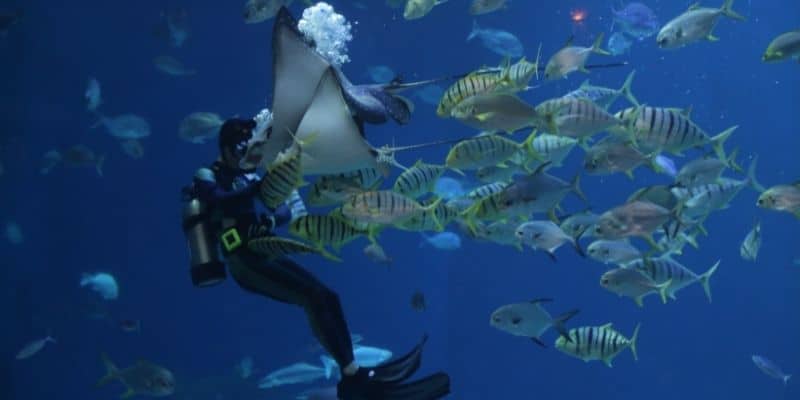
Divers often choose destinations because of what they hope to see underwater.
Marine-life content can target queries such as:
- sharks in Cozumel
- turtles in Akumal
- eagle rays Cozumel season
- whale sharks Cancun season
- manta rays Mexico diving
- best marine life Riviera Maya
This type of content has both informational and commercial value.
A traveler researching eagle ray season may eventually become a dive customer.
Never Guarantee Wildlife Encounters
Wildlife is unpredictable.
Marine life changes according to:
- Season
- Current
- Water temperature
- Migration
- Weather
- Habitat
Avoid statements such as:
“You will see eagle rays.”
Use responsible language:
“Eagle ray encounters are more commonly reported during…”
This protects customer expectations and improves credibility.
Best Time to Publish Seasonal Dive Content
Local SEO should anticipate demand.
A seasonal page should ideally exist before travelers begin searching heavily for that season.
A practical content timeline looks like this:
| Period | SEO Focus |
|---|---|
| 4–6 months before high season | Build destination and service pages |
| 2–4 months before | Publish season, marine-life and weather guides |
| 1–2 months before | Refresh prices, schedules and booking pages |
| Peak season | Focus on Maps, reviews and conversion |
| Shoulder season | Promote alternative dive experiences |
| Low season | Improve technical SEO and future content |
SEO should operate year-round even if the business is highly seasonal.
Weather and Climate Content for Dive Shops
Weather information can attract search traffic while helping customers make better decisions.
Useful topics include:
- Water temperature
- Rainy season
- Hurricane season
- Wind
- Visibility
- Current
- Surface conditions
Do not simply publish climate statistics.
Explain what they mean for a diver.
For example:
“Water temperature averages X°C.”
is less useful than:
“Most divers are comfortable in a 3 mm wetsuit during this period, although individual cold tolerance varies.”
Practical interpretation creates value.
Explain How Weather Affects Diving
Customers may not understand why a dive gets canceled when the sun is shining.
Explain factors such as:
- Wind
- Waves
- Port closure
- Current
- Boat safety
- Visibility
This type of information reduces frustration and demonstrates professionalism.
Google Maps Visibility and Website Conversion Must Work Together
Ranking highly does not guarantee bookings.
Imagine two dive centers.
Dive Center A
Ranks first.
Website is slow.
Prices are unclear.
Booking button does not work.
Dive Center B
Ranks third.
Website loads quickly.
Courses are clearly explained.
Reviews are visible.
Booking takes two minutes.
Dive Center B may generate more revenue.
Local SEO should therefore include conversion strategy.
What Every Dive Shop Service Page Should Include
Each service page should answer:
Who Is This For?
Certified diver?
Beginner?
Advanced diver?
What Happens?
Explain the actual experience.
How Many Dives?
One?
Two?
Three?
What’s Included?
For example:
- Tanks
- Weights
- Guide
- Boat
- Snacks
- Water
- Equipment
What’s Extra?
Examples:
- Marine park fee
- Equipment rental
- Nitrox
- Transportation
Meeting Point
Where exactly?
Duration
What time does it start and finish?
Requirements
Certification?
Minimum age?
Medical form?
Price
Use clear pricing where possible.
Booking
Provide an obvious next step.
Mobile Optimization Is Essential for Local Dive Search
Many local searches happen on mobile phones.
A traveler may search for a dive shop while:
- Sitting in a hotel
- Walking downtown
- Eating breakfast
- Waiting at the airport
- Already standing near the marina
The mobile experience should make it easy to:
- Call
- Open Maps
- Send WhatsApp
- See prices
- Check availability
- Book
- Find the dive shop
Do not assume a beautiful desktop website works equally well on a phone.
Add LocalBusiness Structured Data
Structured data can help search engines understand business information.
Google’s documentation explains that LocalBusiness structured data can provide information such as business details and opening hours.
Useful structured data for a dive shop may include:
- LocalBusiness
- Organization
- BreadcrumbList
- Article
The markup should accurately reflect visible content.
Structured data does not replace a strong Google Business Profile or good website.
Add Breadcrumbs to Dive Shop Websites
Breadcrumbs help users understand the site’s hierarchy.
Google also supports BreadcrumbList structured data.
For example:
Home → Diving → Cozumel Dive Trips → Two-Tank Reef Dive
This helps both navigation and site organization.
NAP Consistency for Dive Shops
NAP stands for:
Name
Address
Phone
Keep these details consistent across important platforms.
Potential sources include:
- Website
- Google Business Profile
- Tourism board
- Dive training organization
- Hotel partners
- Local directories
- Social media
- Travel associations
Minor formatting differences are not necessarily catastrophic.
The larger issue is conflicting information.
If one site lists an old phone number and another lists a new location, customers and search engines may encounter uncertainty.
Local Links Can Strengthen Dive Shop Authority
Relevant local backlinks can support both SEO and referral traffic.
Potential partners include:
- Hotels
- Resorts
- Hostels
- Tourism boards
- Local restaurants
- Travel agencies
- Marina websites
- Dive certification organizations
- Environmental organizations
- Travel blogs
A hotel linking to your dive shop as its recommended diving partner is commercially relevant.
A random directory link from an unrelated foreign website may provide little real value.
Partner With Hotels and Resorts
Hotel partnerships can generate:
- Direct referrals
- Website links
- Concierge bookings
- Package opportunities
- Local authority
Create partner resources that make referrals easy.
For example:
Hotel Guest Diving Guide
could explain:
- Pickup
- Certification requirements
- Schedule
- Equipment
- Pricing
- Booking
Make the partnership useful for both parties.
Local PR for Dive Centers
Local news coverage can also create visibility.
Potential stories include:
- Reef cleanup
- Conservation project
- New dive site research
- Marine-life observation
- Dive safety campaign
- Instructor achievement
- Community event
Do not manufacture meaningless press releases solely for links.
Participate in something genuinely newsworthy.
Dive Shop SEO and Conservation
Environmental expertise can strengthen the dive center’s brand.
Useful topics include:
- Reef protection
- Responsible buoyancy
- Marine park rules
- Wildlife interaction
- Lionfish management
- Coral restoration
- Plastic reduction
Divers often care deeply about the environments they visit.
Explain what the shop actually does.
Avoid vague statements such as:
“We are completely sustainable.”
Specific actions are more credible.
Social Media Supports Local SEO but Does Not Replace It
Instagram is extremely useful for dive businesses.
Underwater photography naturally performs well visually.
But Instagram followers and local Google visibility solve different problems.
Social media creates:
interest
Search captures:
intent
A traveler may first discover Cozumel diving through Instagram.
Later they search:
“best dive shop Cozumel”
Your local SEO strategy should capture that second step.
Google Ads vs. Local SEO for Dive Shops
Both can be valuable.
| Local SEO | Google Ads |
|---|---|
| Builds organic visibility | Buys visibility |
| Strong Google Maps opportunity | Strong commercial targeting |
| Takes time | Can launch immediately |
| Reviews support performance | Ads require ongoing spend |
| Useful long term | Useful for seasonal demand |
| No direct cost per organic click | Paid traffic |
A new dive shop might use paid search while building local organic authority.
An established dive center may use Ads selectively during competitive booking periods.
Google Business Profile and Dive Shop Seasonality
Update the profile throughout the year.
Examples:
Before High Season
Refresh:
- Hours
- Photos
- Services
- Website
- Course schedules
During Peak Season
Focus on:
- Reviews
- Availability
- Fresh photos
- Fast customer responses
Low Season
Update:
- Temporary hours
- Maintenance closures
- New services
- Upcoming season information
Customers should not arrive at a closed dive shop because Google displayed outdated hours.
Multi-Location Dive Operators Need Special Care
A company operating legitimate dive centers in several destinations can have separate profiles.
But each location should represent a real customer-facing operation.
Google warns against creating multiple profiles for a single location or using locations that do not genuinely operate as businesses.
Each real location should have:
- Correct address
- Local phone
- Local page
- Local images
- Local services
- Accurate hours
Do not build fake map pins to dominate an entire coastline.
Common Local SEO Mistakes Dive Shops Should Avoid
Keyword Stuffing the Business Name
Use the real business name.
Creating Fake Locations
Do not create virtual offices to rank in neighboring cities.
Ignoring Reviews
Reviews are important for visibility and trust.
Publishing Thin City Pages
Each page should contain genuine local expertise.
Using Outdated Photos
Customers want to see the current operation.
Ignoring Mobile Users
Travel searches are heavily mobile.
Sending Every Search to the Homepage
Create relevant service pages.
Hiding Prices and Inclusions
Reduce booking friction.
Ignoring Seasonal Search Demand
Publish before peak demand.
Treating Google Maps and Website SEO Separately
They should reinforce each other.
How to Measure Local SEO for Dive Shops
Do not judge success only by whether the shop appears first for one search.
Local rankings change by location.
Instead, monitor multiple metrics.
| Metric | What It Shows |
|---|---|
| Google Maps visibility | Local discovery |
| Website clicks from profile | Local traffic |
| Calls | Commercial intent |
| Direction requests | Physical visits |
| Organic local traffic | Website discovery |
| Course page visits | Service demand |
| WhatsApp inquiries | Leads |
| Completed bookings | Revenue |
| Review growth | Reputation |
| Conversion rate | Website effectiveness |
| Direct booking share | Channel independence |
The most important measurement remains:
Does local visibility produce profitable bookings?
Track Branded vs. Non-Branded Search
Branded search:
Blue Reef Diving Cozumel
means the customer already knows you.
Non-branded search:
dive shop Cozumel
means the customer is discovering options.
Increasing non-branded local visibility can introduce the dive center to entirely new customers.
Track both.
Local SEO and Direct Bookings
One of the greatest benefits of local SEO for dive shops is its ability to support direct bookings.
Consider this path:
Google Maps search
↓
Business Profile
↓
Reviews
↓
Website
↓
Two-Tank Dive Page
↓
Booking
No OTA is required.
That does not mean third-party platforms are always bad.
They can provide valuable distribution.
But building a reliable direct-search channel gives the dive shop more control.
Practical Local SEO Checklist for Dive Shops
Google Business Profile
- Verify the profile.
- Use the real business name.
- Confirm the correct address.
- Choose accurate categories.
- Add services.
- Update hours.
- Add photographs.
- Build reviews.
- Respond to reviews.
Website
- Create a clear destination page.
- Build individual service pages.
- Display location information.
- Optimize for mobile.
- Add booking CTAs.
- Improve page speed.
- Add LocalBusiness schema.
- Use internal links.
Content
- Create destination guides.
- Cover marine life.
- Publish seasonal information.
- Answer beginner questions.
- Explain weather.
- Cover certifications.
- Update old articles.
Local Authority
- Build hotel partnerships.
- Join relevant tourism organizations.
- Earn local links.
- Maintain accurate business information.
Conversion
- Display prices.
- Explain inclusions.
- Add WhatsApp.
- Make booking simple.
- Show real reviews.
- Explain cancellation policies.
A 90-Day Local SEO Plan for Dive Shops
Days 1–30: Fix the Foundation
Audit:
- Google Business Profile
- Business categories
- Address
- Hours
- Reviews
- Website
- Local pages
- Mobile performance
- Booking system
Correct inconsistencies.
Days 31–60: Build Local Relevance
Improve or create:
- Main destination page
- Dive service pages
- Course pages
- Marine-life content
- Seasonal diving guide
- Internal links
Begin systematic review acquisition.
Days 61–90: Build Prominence and Conversion
Develop:
- Hotel partnerships
- Tourism links
- Local PR
- Strong review volume
- Better booking UX
- Conversion tracking
Then evaluate performance before expanding.
Frequently Asked Questions About Local SEO for Dive Shops
What is local SEO for dive shops?
Local SEO for dive shops is the process of improving a dive business’s visibility in geographically relevant Google Search and Google Maps results.
How does Google rank dive shops in Maps?
Google states that local rankings are primarily based on relevance, distance, and prominence.
Are Google reviews important for dive shop SEO?
Yes. Google states that the number of reviews and positive ratings can contribute to local ranking, while reviews also strongly influence customer trust.
Does every dive shop need a Google Business Profile?
A customer-facing local dive business generally benefits substantially from one. Google Business Profile is designed for businesses that interact with customers at a physical location or within a local service area.
Can a dive operator use a home address on Google Maps?
If customers do not visit that location, the business should generally operate as a service-area business and hide the address rather than presenting a private location as a storefront.
Should dive shops create pages for every nearby destination?
No.
Create destination pages only when the business genuinely operates there and can provide meaningful local information.
Is Google Maps more important than the dive shop website?
They perform different roles.
Maps can generate discovery.
The website provides much greater control over services, pricing, education, trust, and booking conversion.
The strongest strategy connects both.
How often should a dive shop update its Google profile?
Update whenever important business information changes.
Seasonal dive businesses should pay particular attention to current hours, photos, services, and contact information before peak travel periods.
Should dive shops publish marine-life articles?
Yes, when the content genuinely relates to the destination.
Marine-life searches can attract travelers early in trip planning and naturally connect to dive services.
How long does local SEO take?
There is no guaranteed timeline.
Performance depends on the destination, competition, proximity, website authority, reviews, existing visibility, and many other factors.
Final Thoughts: Local SEO Can Turn Google Maps Into a Booking Channel
The most effective local SEO for dive shops is not about finding a trick that forces a business to the top of Google Maps.
Google’s own documentation makes the fundamentals clear.
Local visibility depends heavily on:
relevance
distance
and
prominence.
You cannot control every factor.
You cannot move the dive shop closer to every traveler.
But you can make the business far easier for Google and customers to understand.
Maintain an accurate Google Business Profile.
Build genuine reviews.
Create useful destination pages.
Explain your dive services.
Publish real local knowledge.
Share seasonal conditions.
Show the marine life divers actually travel to see.
Maintain accurate location information.
Earn relevant local links.
Optimize the mobile booking experience.
And make the journey from:
Google Maps → website → confidence → reservation
as simple as possible.
A dive shop already possesses something most generic travel websites do not:
firsthand local diving expertise.
Your instructors know the reefs.
Your captains know the conditions.
Your divemasters know the marine life.
Your team understands which sites work for beginners, where current becomes difficult, when visibility changes, and what customers ask every day.
Turn that expertise into your local digital presence.
When Google Maps visibility, website SEO, reviews, local content, and booking conversion work together, local search becomes much more than a ranking exercise.
It becomes a sustainable direct-booking channel for the dive shop.


 Spanish
  English
  French